

ChipsetFrom Wikipedia, the free encyclopedia
This article needs additional citations for verification. Please help improve this article by adding citations to reliable sources. Unsourced material may be challenged and removed. (November 2017) (Learn how and when to remove this template message)
In a computer system, a chipset is a set of electronic components in an integrated circuit that manages the data flow between the processor, memory and peripherals. It is usually found on the motherboard. Chipsets are usually designed to work with a specific family of microprocessors. Because it controls communications between the processor and external devices, the chipset plays a crucial role in determining system performance.
Intel ICH7 Southbridge on Intel D945GCPE Desktop Board
Contents
1 Computers
2 Move toward processor integration in PCs
3 See also
4 Notes
Computers
In computing, the term chipset commonly refers to a set of specialized chips on a computer's motherboard or an expansion card. In personal computers, the first chipset for the IBM PC AT of 1984 was the NEAT chipset developed by Chips and Technologies for the Intel 80286 CPU.
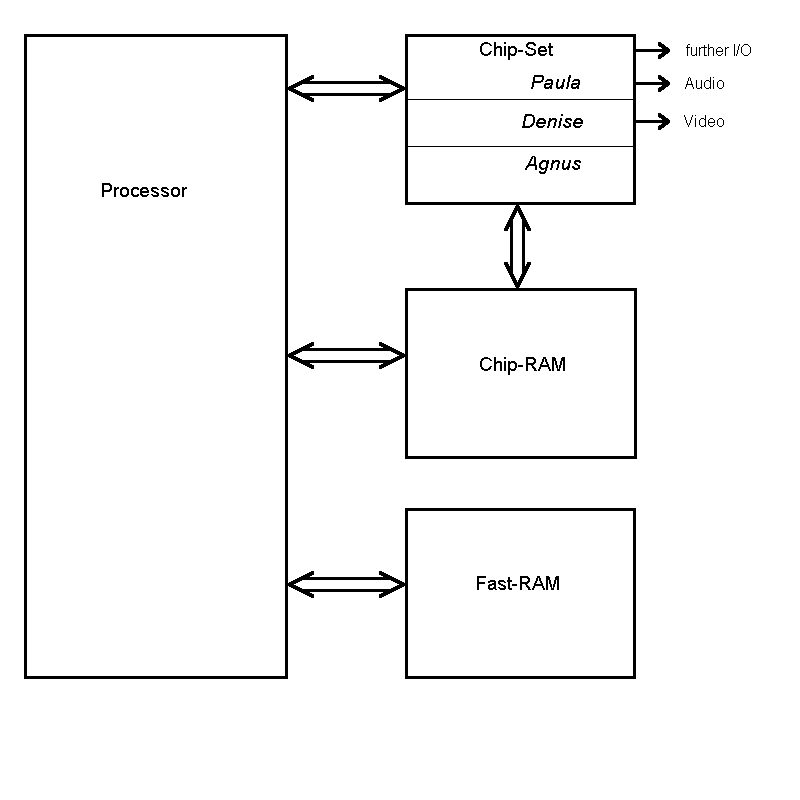
Diagram of Commodore Amiga's Original Chip Set
A part of an IBM T42 laptop motherboard. CPU: Central processing unit. NB: Northbridge. GPU: Graphics processing unit. SB: Southbridge.
In home computers, game consoles and arcade-game hardware of the 1980s and 1990s, the term chipset was used for the custom audio and graphics chips. Examples include the Commodore Amiga's Original Chip Set or SEGA's System 16 chipset.
The term chipset often refers to a specific pair of chips on the motherboard: the northbridge and the southbridge. The northbridge links the CPU to very high-speed devices, especially RAM and graphics controllers, and the southbridge connects to lower-speed peripheral buses (such as PCI or ISA). In many modern chipsets, the southbridge contains some on-chip integrated peripherals, such as Ethernet, USB, and audio devices.
Motherboards and their chipsets often come from different manufacturers. As of 2015, manufacturers of chipsets for x86 motherboards include AMD, Broadcom, Intel, NVIDIA, SiS and VIA Technologies. Apple computers and Unix workstations have traditionally used custom-designed chipsets. Some server manufacturers also develop custom chipsets for their products.
In the 1980s, Chips and Technologies pioneered the manufacturing of chipsets for PC-compatible computers. Computer systems produced since then often share commonly used chipsets, even across widely disparate computing specialties. For example, the NCR 53C9x, a low-cost chipset implementing a SCSI interface to storage devices, could be found in Unix machines such as the MIPS Magnum, embedded devices, and personal computers.
Move toward processor integration in PCs
Traditionally in x86 computers, the processor's primary connection to the rest of the machine was through the motherboard chipset's northbridge. The northbridge was directly responsible for communications with high-speed devices (system memory and primary expansion buses, such as PCIe, AGP and PCI cards, being common examples) and conversely any system communication back to the processor. This connection between the processor and northbridge is traditionally known as the front side bus (FSB). Requests to resources not directly controlled by the northbridge were offloaded to the southbridge, with the northbridge being an intermediary between the processor and the southbridge. The southbridge traditionally handled "everything else", generally lower-speed peripherals and board functions (the largest being hard disk and storage connectivity) such as USB, parallel and serial communications. The connection between the northbridge and southbridge does not have a common name, but was usually a high-speed interconnect proprietary to the chipset vendor.
Before 2003, any interaction between a CPU and main memory or an expansion device such as a graphics card(s) — whether AGP, PCI or integrated into the motherboard — was directly controlled by the northbridge IC on behalf of the processor. This made processor performance highly dependent on the system chipset, especially the northbridge's memory performance and ability to shuttle this information back to the processor. In 2003, however, AMD's introduction of the Athlon 64-bit series of processors[1] changed this. The Athlon64 marked the introduction of an integrated memory controller being incorporated into the processor itself thus allowing the processor to directly access and handle memory, negating the need for a traditional northbridge to do so. Intel followed suit in 2008 with the release of its Core i series CPUs and the X58 platform.
In newer processors integration has further increased, primarily through the inclusion of the system's primary PCIe controller and integrated graphics directly on the CPU itself. As fewer functions are left un-handled by the processor, chipset vendors have condensed the remaining northbridge and southbridge functions into a single chip. Intel's version of this is the "Platform Controller Hub" (PCH), effectively an enhanced southbridge for the remaining peripherals—as traditional northbridge duties, such as memory controller, expansion bus (PCIe) interface and even on-board video controller, are integrated into the CPU itself (the chipset often contains secondary PCIe connections though). However, the Platform Controller Hub was also integrated into the processor for certain models of Intel's Skylake processors.


ความคิดเห็น
แสดงความคิดเห็น